

Men’s Therapy in Calgary
Men’s Mental Health
Practical, evidence-based therapy for men navigating stress, performance, relationships, identity, and responsibility.

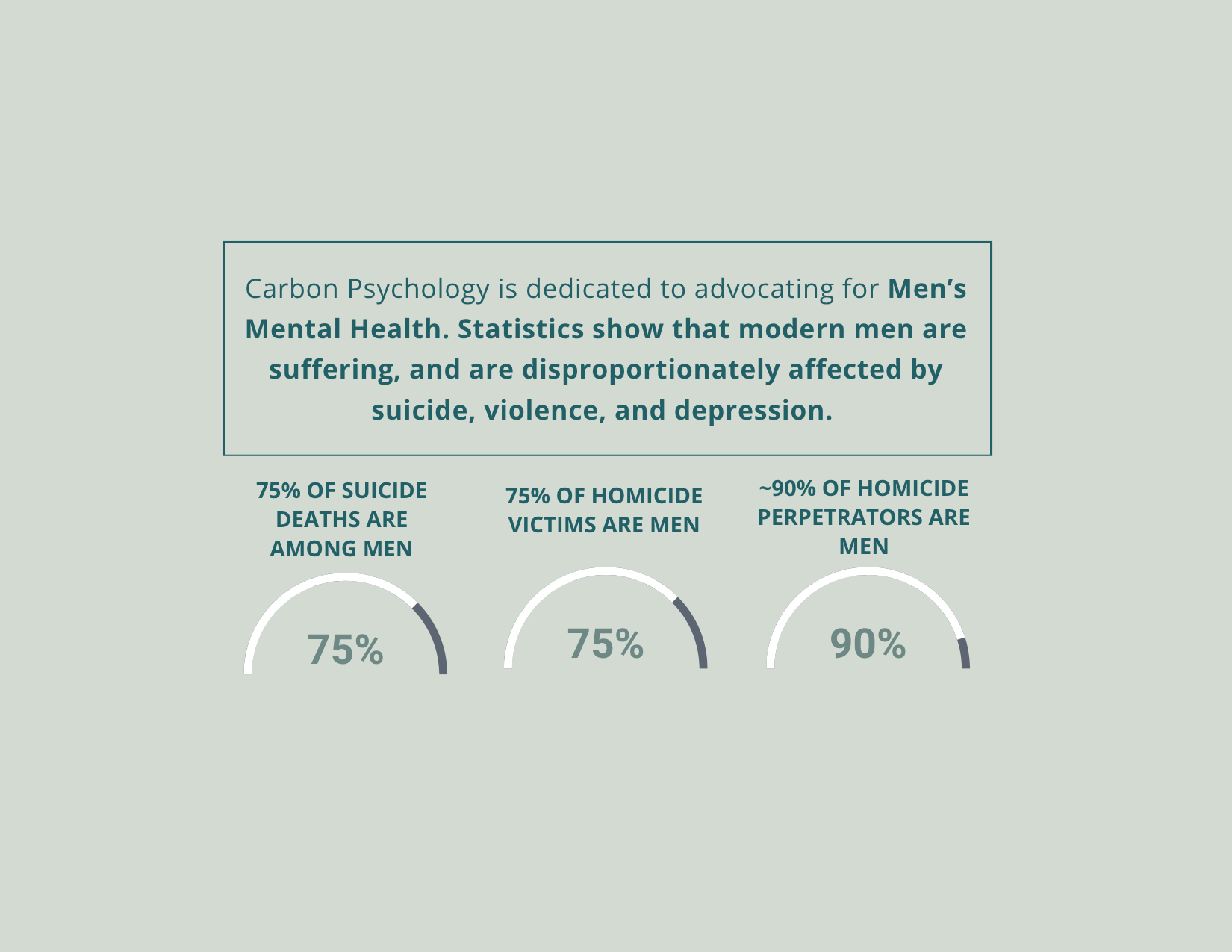
Sources: Centre for Suicide Prevention & Statistics Canada
The Reality for Many Men.
You might feel like:
You’re constantly “on,” but feel exhausted underneath it
You have a hard time switching off, even when you want to
Anger or frustration comes out faster than you’d like
You avoid certain conversations because they feel too heavy or unpredictable or its “just not worth it”
You feel disconnected in your relationships, even when you care
You question your direction, but don’t know what to change
When you’ve tried to talk about something in the past, it hasn’t been received well
How Does Therapy Help Men?
Therapy offers men a confidential space to slow down, reflect, and make sense of what they’re carrying. It helps build emotional awareness, strengthen relationships, and develop healthier ways of coping with stress, pressure, and life transitions.
Key benefits include:
Emotion regulation
Communication and relationship skills
Build secure attachment patterns
Stress and anger management
Improved self-esteem and self-worth
Alignment and clarity on goals and purpose
Clarity in decision making
Confidence and self-understanding
Therapists with a special interest in men’s mental health
Below is a brief snapshot of each therapist’s focus. Click on their photo to read more.

Angelo Sison, Registered Psychologist

Michael Grisonich, Registered Provisional Psychologist

Joe Seddon, Canadian Certified Counsellor

Tim Maxwell, Canadian Certified Counsellor

Melissa Penney, Canadian Certified Counsellor - Qualifying

Jeremy Fonteyne, Registered Provisional Psychologist
Melissa works with clients to understand the root of sex addiction and dysfunction, relational challenges, and patterns of perfectionism and self-sabotage.
She has specialized experience with nutrition, physical health, medical diagnoses, and supporting women and their partners through the changes that come with menopause.
As a sensitive man, Jeremy has a particular interest in helping men to explore emotion in greater depth and to explore the many sides of masculinity.
He specializes in ADHD and ODD and phone addiction, helping individuals to understand their behaviour, reduce anxiety, and better manage their lives.

Nick Pyke, Master of Counselling Psychology Intern - *Reduced Rate
Nick specializes in working with military personnel, first responders, and uniformed service members navigating chronic stress, performance pressure, PTSD, identity shifts during career transitions, and the specific weight of professions that require you to keep functioning no matter what.
Michael is direct and grounded. He has a special interest in supporting people to navigate conflicting emotions, tension in relationships, or a sense that their reactions feel out of alignment for what they want for themselves.
Angelo has a practical, warm, and meaningful approach to therapy. He connects with clients through shared interests of sports and fitness, and works to promote client’s inner strength and self-worth.
Tim takes an action-oriented approach to change, combining humour with practical, solution-focused strategies to help clients regain direction, build momentum, and make changes that actually stick. He also has a background in the trades and works with men navigating behavioural addictions.
Joe specializes in performance, healing shame, and improving self-worth. He’s light-hearted, funny, and compassionate in how he shows up in his life and his work.

Men’s Group
Carbon Psychology’s Signature Program
Fall Group: September 8 2026, Tuesdays, 6:30pm-8:00pm
Winter Group: January 17 2027, Tuesdays, 6:30pm-8:00pm
Cost & Coverage
$110 per session (aligned with the PAA’s recommended group rate)
Billable to most insurance plans that cover psychological services
Payment is made per session. Receipts are provided for insurance reimbursement.
For New and Expecting Fathers
Becoming a father can be meaningful, but also disorienting in ways that aren’t always talked about. Alongside the responsibility and pressure to show up, many men find themselves navigating stress, sleep deprivation, changes in their relationship, and a shifting sense of identity.
This can be helpful if you’re noticing:
Increased stress, frustration, or pressure
Changes in your relationship after having a child
Feeling disconnected or unsure of your role
Difficulty balancing responsibility, work, and family
A sense that things have shifted, but you’re not sure how to adjust
Fear about the responsibility of being a new parent
Feeling unsure about how to support your partner through body and hormonal changes
Jeremy Fonteyne, Registered Provisional Psychologist
Jeremy works with men adjusting to fatherhood, including the emotional, identity, and relational shifts that come with it. However you became a parent (pregnancy, adoption, IVF, or surrogacy), the early stages can bring real pressure, and real loneliness. Sessions focus on processing the change, finding your footing in the new role, and learning how to show up for your partner and your child in a way that feels grounded and sustainable.
When the woman in your life is going through something hormonal
Many men in long-term partnerships will, at some point, find themselves living alongside a major hormonal transition: pregnancy, postpartum, perimenopause, or menopause. These transitions affect mood, sleep, energy, libido, identity, and relationships in ways that are real, often poorly understood, and rarely talked about openly between partners.
Some of what follows also applies to other women in your life — mothers, sisters, daughters, close friends — though the relational dynamics differ. Most of this section speaks to romantic partners, since that's where men most often feel the impact and most often need to know how to respond.
A few things worth knowing:
Postpartum is not just baby blues. Postpartum depression and anxiety affect a significant percentage of new mothers and can begin weeks or months after birth. Symptoms include withdrawal, irritability, intrusive thoughts, exhaustion that sleep doesn't fix, and loss of interest in things that used to matter. Most postpartum mood difficulty isn't visible until it's well established, and the partner's awareness is often what gets a woman the support she needs in time.
Perimenopause starts earlier than most people realize. It can begin in a woman's late thirties or early forties and last for years before menopause itself. Symptoms include sleep disruption, mood swings, anxiety that wasn't there before, sudden rage, brain fog, and changes in libido. Many women don't know that's what's happening, because the cultural conversation is mostly about menopause itself, not the years leading up to it.
Menopause has its own arc. The fluctuations of perimenopause stabilize, but new patterns settle in. Some women describe the post-menopausal period as a kind of liberation. Others describe a quieter form of grief about who they were before. Both are common.
What this means for partners
Hormonal transitions are not a problem to be fixed, and the goal isn't for men to become amateur endocrinologists. The goal is to be informed enough that you don't take what's happening personally, react defensively, or assume your partner has changed for reasons that have to do with you.
A few things that often help:
Recognizing when something has shifted, and naming it without making it a confrontation
Not treating mood changes, libido changes, or emotional volatility as personal rejection
Carrying more of the household and emotional load during harder periods, without requiring it to be earned or explained
Creating space for your partner to talk without trying to solve the experience
Encouraging professional support when symptoms are significant, while staying alongside her rather than handing her off
What men often discover, when they actually engage with this, is that the relationship deepens. Partners who show up with awareness and steadiness rather than withdrawal or frustration tend to come out of these years closer to their partners, not further apart.
Therapy for men supporting partners through hormonal transitions
Some of our work with men is about navigating their own response to what their partners are going through. Common experiences:
The confusion of feeling like the relationship has changed without anything obvious causing it
Feeling personally rejected when your partner is irritable, withdrawn, or distant, even when you know it isn't about you
The guilt about feeling frustrated with someone going through something difficult
Carrying more of the household and emotional load without acknowledgment, while feeling unable to talk about it
Wondering if this is the new normal, or whether the partner you knew is still there
The grief of feeling unseen by someone who used to see you clearly
These reactions are normal, and they're worth working through directly rather than swallowing or pretending they aren't happening. Many of our clients find that this work makes them more present, more grounded, and less reactive, which often improves the relationship more than trying to be perfectly patient through gritted teeth.
More about Women’s Health and our therapists who work in this area
Looking for more?
Whether you want to start therapy, support our advocacy work, or hear directly from our founder on why men's mental health matters, there are a few ways to go deeper.
Finding the Right Fit.
Some men want a more direct, practical approach. Others want to understand themselves at a deeper level. We have therapists that work in both ways so that you can work with who fits you best.
The goal is not to change who you are, but to help you relate to yourself and your life in a way that feels more clear, grounded, and sustainable.
The therapists on our men's mental health team work with EMDR, Internal Family Systems (IFS), Cognitive Behavioural Therapy (CBT), Acceptance and Commitment Therapy (ACT), Gottman Method (for couples), Exposure and Response Prevention (ERP), narrative therapy, somatic and nervous system-based work, and other evidence-based approaches, depending on what you need.
Why Many Men Don’t Seek Support.
For a lot of men, therapy, or even just talking about what you’re going through, isn’t something that feels natural or familiar.
You may have learned to handle things on your own, push through, or stay focused on what needs to get done. Talking about what’s going on internally can feel uncomfortable, unnecessary, or even like something you should already have figured out.
Therapy doesn’t require you to be a certain way. It’s simply a space to step back, understand what’s happening, and decide how you want to move forward.
FAQ
-
Is it normal to feel stressed, irritable, or shut down all the time?
Yes. Many men experience stress as irritability, frustration, or emotional shutdown rather than sadness. It’s often a sign that something is building under the surface, even if it’s hard to name.
-
Why is it so hard to talk about what I’m feeling?
A lot of men haven’t been taught how to identify or express emotions, or have learned to push things down to stay functional. That doesn’t mean the feelings aren’t there, just that they’re harder to access or put into words.
-
Do I have to open up right away in therapy?
No. Therapy doesn’t require you to share everything immediately. It’s a process, and it’s okay to take time to get comfortable and figure out how you want to talk about things.
-
How do I know if I actually need therapy?
If you’re feeling consistently stressed, disconnected, stuck, or like something isn’t working, whether in your relationships, work, or day-to-day life, it’s worth exploring. You don’t need to be in crisis to benefit from support.
-
What does therapy actually look like for men?
Therapy is usually more practical and conversational than people expect. It often focuses on understanding patterns, improving communication, managing stress, and working through decisions or challenges in a more clear and grounded way.
-
Can therapy help if I don’t know exactly what’s wrong?
Yes. A lot of men come in without a clear label for what they’re experiencing, just a sense that something feels off. Therapy helps make sense of that and figure out what needs to shift.