

Michael Grisonich
Registered Provisional Psychologist
Supporting individuals navigating complex and severe anxiety, OCD, panic, existential dread, and the unconscious patterns playing out in personality and relationships.
Availability: Accepting New Clients
In-person (Calgary) or Online (Alberta).
*Currently No Waitlist
Michael Works With:
Teens & Adults
Individuals & Group Therapy
Service Areas: Alberta
Phone: 587-353-3445, Ext. 207
Email: michael@carbonpsychology.ca

Michael is a Registered Provisional Psychologist who works with individuals navigating complex and severe anxiety, OCD, panic, existential dread, depression, and the unconscious patterns playing out in personality and relationships. Many of his clients have been in therapy before and are looking for work that is either deeper or more targeted to their particular problem.
The kind of therapy provided depends upon the person and the issue they're dealing with. For OCD and many forms of anxiety, Exposure and Response Prevention (ERP) is the gold-standard treatment, used alongside CBT, MCT, and ACT. For clients drawn to deeper work — and for many who have completed a structured course of treatment — the focus shifts to psychodynamic and existential questions: identity, meaning, unconscious relational patterns, and resolving what sits beneath the symptoms.
Michael’s Approach.
Michael pays close attention to what's actually happening: what someone avoids, how they move through relationships, and where they keep getting stuck. He takes his clients' experiences and sense of meaning seriously, and that respect shapes how he listens and how he responds.
He places a strong emphasis on both insight and action, not just understanding what's happening, but developing the ability to respond differently over time. His work is particularly well-suited for those who want to engage deeply with their experience while also making concrete, measurable change.
What it’s like to work with Michael.
Sessions with Michael are direct, focused, and collaborative. He brings ease and humour into the room without losing sight of purpose.
Clients often find the work more approachable than they expected, and deeper too. There is a genuine rigour to it, even when the path is not entirely predictable. People often find themselves willing to go to more difficult places than they thought they would.
Over time, they begin to relate to their thoughts, emotions, and reactions in a more flexible and grounded way.
Personal Note
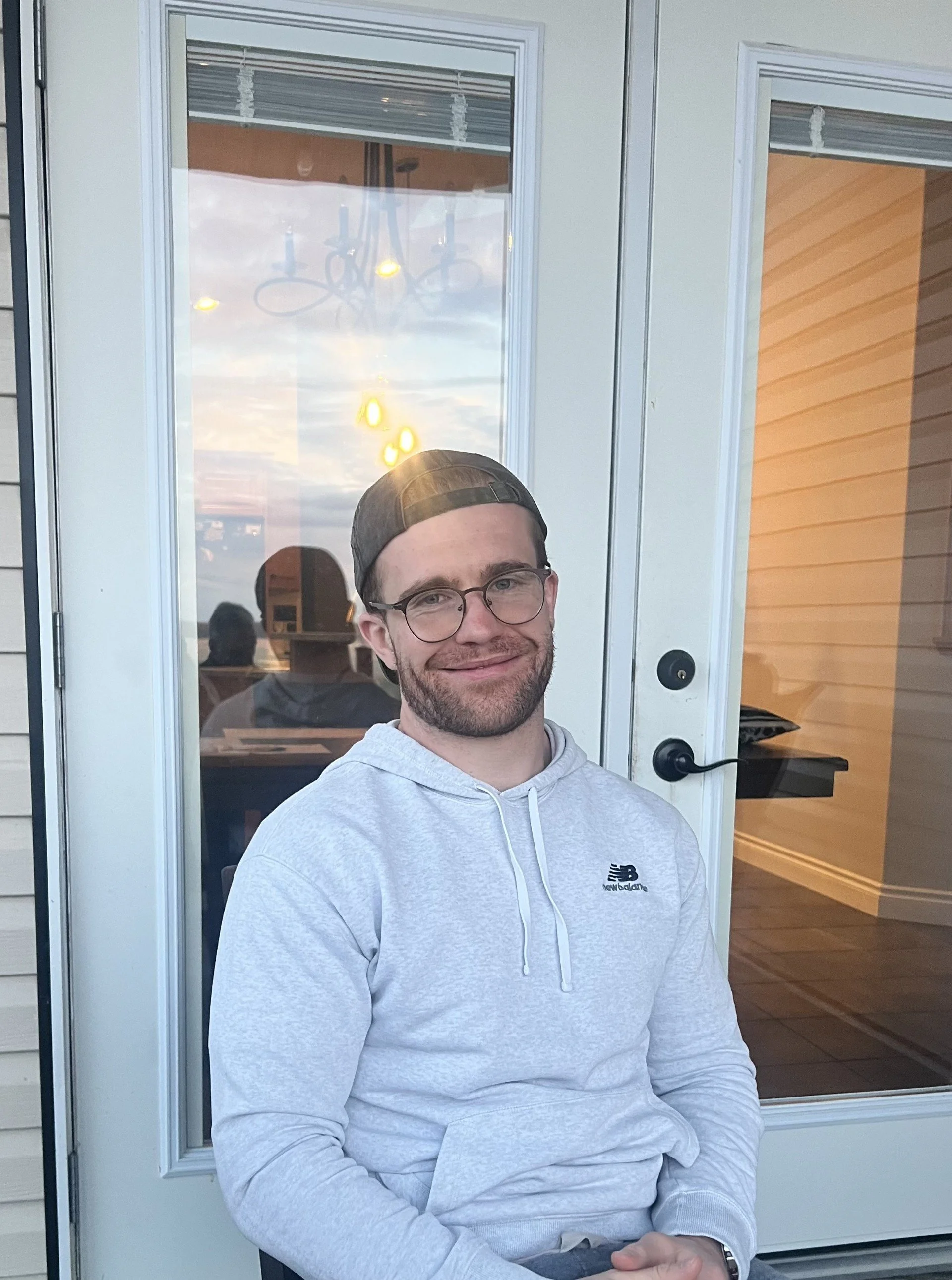
I have a longstanding interest in literature, philosophy, and history. Authors I have been enjoying lately include Tolstoy, Graham Greene, Flannery O'Connor, and on the psychology side, Nancy McWilliams. Good fiction and good psychology tend to ask the same questions.
I travel when I can and have always been drawn to other cultures. In 2020, I left Southern Alberta to teach English at a university in Saigon, Vietnam, where I lived for nearly two years. I loved it there.
I enjoy lifting weights and have always found truth in the idea that to get out of your head, you have to get into your body.


Education.
Masters of Arts in Counselling Psychology (Yorkville University)
Masters of Arts in Interdisciplinary Studies (Athabasca University)
Former teacher at a public university in Vietnam
Former teacher with Quebecois members of the Canadian Armed Forces.
Post-graduate training in ERP for OCD, ACT for OCD, ACT for anxiety, and short-term psychodynamic therapy
Michael Helps With.
OCD • Complex & Severe Anxiety • Panic Disorder • Social Anxiety • Phobias • Rumination • Depression • Existential Concerns • Identity • Personality & Relationship Patterns • Trauma • Men's Mental Health
Group Therapy for Social Anxiety
Group Therapy for Men
ERP Therapy for OCD
Break free from the cycle of obsessions and compulsions.
Living with OCD can feel exhausting. Intrusive thoughts seem to appear out of nowhere, and compulsions—like checking, repeating, or seeking reassurance—can feel near-impossible to resist. Even when you know these rituals don’t fully make sense, the anxiety can be overwhelming.
OCD creates a self-reinforcing cycle: obsessions trigger anxiety, compulsions bring brief relief, and the cycle begins again.
The good news? This cycle can be broken.
Why ERP?
Exposure and Response Prevention (ERP) is considered the first-line treatment for OCD by leading mental health organizations worldwide.
With ERP, you gradually face fears in a safe, structured way while resisting compulsions. This creates opportunities for new learning—your brain begins to recognize that anxiety can naturally rise and fall on its own, and that feared outcomes are often far less dangerous than they seem.
Research suggests that ERP can even lead to changes in the brain circuits involved in OCD. While no treatment works for everyone, many people who engage in ERP experience meaningful relief, freeing them up to spend their time and mental energy on what matters most.
Psychodynamic (Depth) Therapy
For those who sense the problem runs deeper than the symptoms.
Some people come to therapy not with a discrete diagnosis but with a persistent sense that something underneath isn't right — recurring patterns in relationships, a feeling of emptiness or inauthenticity, chronic low mood, anxiety that resists explanation, or questions about who they are and what their life means.
Psychodynamic therapy is an evidence-based treatment with a substantial research base supporting its effectiveness for depression, anxiety, personality difficulties, and relational problems. Unlike symptom-focused approaches, it works by bringing unconscious patterns, defences, and relational dynamics into awareness — and over time, changing them.
The work is exploratory and collaborative. It attends to what a person avoids, how they relate, and what their experience has come to mean to them. Psychodynamic therapy has a strong evidence base, and research suggests its effects tend to persist and even grow after treatment ends.
This work requires commitment. Clients who attend infrequently or plan on only a few sessions are better served by a more structured, problem-focused approach.